
European Society of Toxicologic Pathology
ESTP/GTP meeting 2002: Case No 16b
case index | << previous case | next case >>
|
|

Abstract
J. HELLMANN
Institute of Toxicology, Merck KGaA, Frankfurter Str. 250, 64271 Darmstadt, Germany
Key words: port catheter infusion technique, cynomolgus monkey, septicaemia
To support clinical trials, 44 cynomolgus monkeys received intermittent short-term infusions (1 h, 3x per week) for a period of 39 weeks. In order to avoid stress, perivenous inflammation, or thrombosis a vascular access port system (VAP) was used. This comprised a port device in the back with a catheter to the femoral vein, both implanted entirely subcutaneously with access via a minipump and needle.
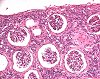
Five deaths occurred within the first 10 weeks of treatment. Embolic purulent inflammation and bacteraemia were seen in multiple organs, associated with exhaustion of the immune system. The kidneys exhibited various lesions, from acute purulent-embolic nephritis and disseminated intravascular coagulation with acute bilateral cortical necrosis to chronically shrunken kidneys after 39 weeks. Bacteriology revealed that staphylococcus aureus accounted for most of the lesions observed with E. coli contributing in some cases. In conclusion, intermittent infusions bear the risk that bacteria might proliferate inside the implanted ports or catheters if residual amounts of administered solution in the devices are contaminated during skin penetration despite careful precautions.